
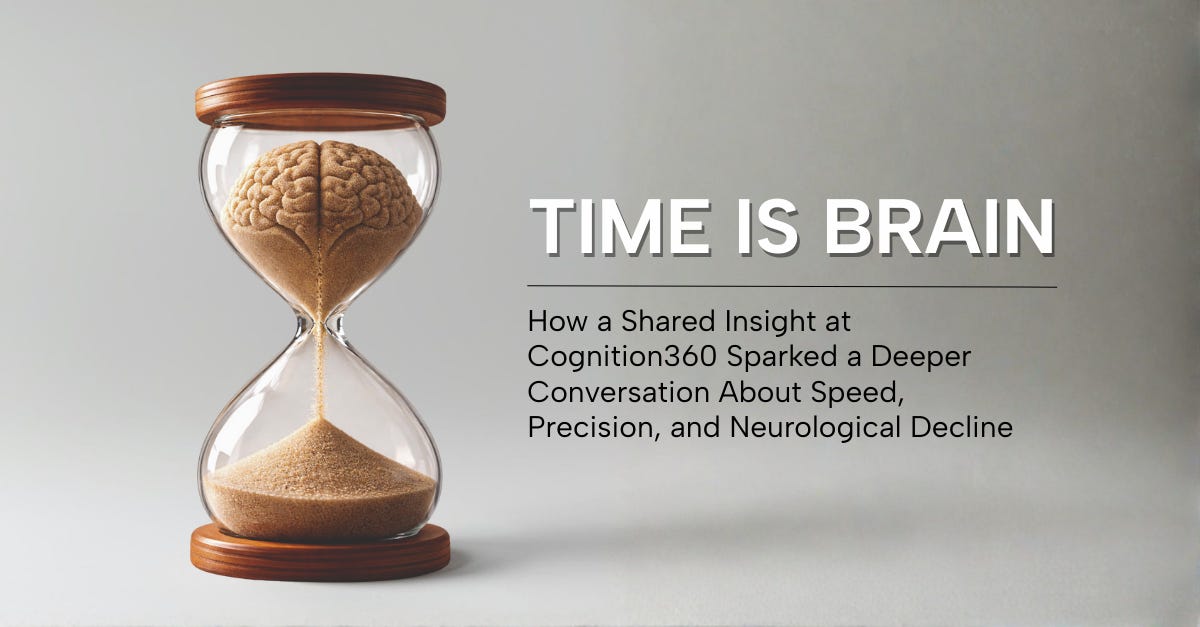
Time Is Brain
How a Shared Insight at Cognition360 Sparked a Deeper Conversation About Speed, Precision, and Neurological Decline

Last May, something subtle but important happened after the conference at Cognition360.
Two keynote speakers, coming from different disciplines, different training backgrounds, and different lanes of medicine realized they were speaking the same language.
Kristine Burke, MD, co-founder of TruNeura and a clinician deeply immersed in reversing cognitive decline, and Christopher Shade, PhD, a delivery-systems chemist, both found themselves returning to the same core principle:
Time is brain.
Dr. Burke was presenting clinical outcomes, patients with cognitive decline who improved dramatically when the right interventions were applied early and decisively.
Dr. Shade was presenting pharmacokinetics, data showing that how fast and how reliably support reaches the brain can determine whether an intervention works at all.
Different perspectives.
Same conclusion.
That moment of recognition “we’re solving the same problem from two angles” is what inspired this deeper conversation.
Neurological Decline Is a Race Against Time
In cardiology, we say time is muscle.
In neurology, the stakes are even higher.
Neurological decline is rarely slow and linear. It often unfolds in accelerated phases triggered by inflammation, oxidative stress, vascular compromise, toxic exposure, infection, or metabolic breakdown. During these windows:
Neurons are exceptionally vulnerable
Synapses are lost rapidly
Mitochondrial dysfunction compounds damage
Repair mechanisms are overwhelmed
From the clinical side, Dr. Burke has seen this repeatedly: the difference between recovery and progression often comes down to how fast support is mobilized.
From the chemistry side, Dr. Shade has spent decades asking a parallel question: What if the intervention never arrives in time or never arrives at all?
The Missing Link: Delivery Speed
Most clinicians are trained to think first about what to give.
Increasingly, the limiting factor is how fast it gets there.
At Cognition360, the shared realization was this:
You can have the right molecule, the right protocol, and the right intention but if delivery is slow, inconsistent, or degraded, the brain doesn’t get the help when it needs it most.
This is especially true in cognitively vulnerable patients, where:
Digestion may be impaired
Bile production may be compromised
Gut integrity may be reduced
First-pass metabolism may destroy actives
In these patients, delivery technology becomes a clinical variable, not a technical detail.
Precision Liposomal Delivery: Engineering for Speed
In our upcoming webinar, Acting Fast in Neurological Decline: The Clinical Advantage of Precision Liposomal Delivery, Dr. Shade walks clinicians through:
Why conventional oral delivery often fails in brain-focused care
How liposomal and nanoemulsion systems bypass absorption bottlenecks
Why particle size, stability, and transparency directly determine uptake
Quicksilver’s formulations are engineered with small, consistent particle sizing, designed for rapid transit from ingestion to systemic circulation—even when the gut is compromised.
This isn’t about marketing buzzwords. It’s about engineering for time sensitivity.
Evidence That Speed Matters
Dr. Shade also reviews data, including a particle-size and absorption study conducted with the National Institute of Standards and Technology (NIST), demonstrating:
Smaller, uniform particles correlate with faster and more reliable absorption
Stable, transparent formulations outperform cloudy, unstable emulsions
Delivery chemistry predicts clinical consistency
He pairs this with real-world Quicksilver uptake and absorption data, offering clinicians something rare: visibility into how delivery systems actually perform outside of theory.
Matching the Tool to the Moment
One of the key insights from Cognition360—and from this webinar—is that not all delivery systems are interchangeable.
Clinicians will learn to:
Distinguish when liposomal delivery is ideal
Recognize when nanoemulsions are the better choice
Match particle architecture to the specific active and clinical goal
This mirrors how precision brain medicine itself is evolving: right intervention, right patient, right timing.
What’s Next: Oral Liposomal Peptides
The webinar also introduces emerging oral liposomal peptide technologies, an exciting frontier for brain resilience and repair.
These tools are being explored for their ability to:
Support neuroplasticity
Enhance repair signaling
Improve resilience during inflammatory or metabolic stress
While early, they represent a continuation of the same principle that united Dr. Burke and Dr. Shade on that Cognition360 stage: speed and precision matter when the brain is at risk.
Why This Matters Now
The phrase time is brain isn’t just a slogan. It’s a call to action.
As precision medicine reshapes how we approach neurological decline, delivery speed is becoming one of the most important—and underappreciated—clinical levers we have.
That shared realization last May wasn’t accidental. It was inevitable.
Because when clinicians and chemists start solving the same problem from different directions, a new standard of care begins to emerge.
And that conversation is continuing.
Join Us: Acting Fast in Neurological Decline
On Wednesday, January 14, we’re hosting a focused clinical webinar that builds directly on this insight—examining why how fast support reaches the brain can determine whether an intervention succeeds at all.
🧠 Acting Fast in Neurological Decline: The Clinical Advantage of Precision Liposomal Delivery
📅 January 14 | 4:00pm PT / 7:00pm ET
🎙 With Dr. Chris Shade (Quicksilver Scientific) and James Maskell
In this session, we’ll explore:
Why speed of delivery matters in neurological decline
Liposomal vs. nanoemulsion technologies—and when each is appropriate
How particle size, stability, and formulation precision drive real-world outcomes
Emerging insights into oral liposomal peptides for brain resilience
In brain health, decline isn’t linear—and time isn’t neutral. Cognitive points are being lost in real time. The question is no longer whether improvement is possible, but how quickly and precisely we act.
Solid framing on delivery kinetics. The particle size data from NIST is exactly the kind of engineering rigor that's been missing from supplement discourse. I've always wondered if the obsession with what to take overshadows when and how fast it arrives. The analogy to cardiology's "time is muscle" lands perfectly here because in both cases theres this window where intervention either works or becomes irrelevant.
Clarification: does the reference to time mean how quickly a patient comes into treatment and gets started on a protocol or how quickly the applied therapeutic once ingested gets to the brain? Actually, maybe it's both?
"The question is no longer whether improvement is possible, but how quickly and precisely we act." Yes, there is real progress and it's great how you keep us informed. Thank you.