

“Some people just don’t respond.”
That observation shaped much of Dr. Werner Vosloo ND’s work long before he began focusing specifically on cognitive decline.
Dr. Vosloo is the founder of Restore BioClinic and in this week’s TruNeura Mastermind he described the clinical problem that kept appearing throughout his years in practice: patients who follow the plan, take the right nutrients, address the obvious issues, and still do not improve in the way expected.
His question became more basic.
What is preventing the body from responding?
That question led him into cell biology, chronic inflammation, infectious burden, detoxification, membrane structure and, increasingly, the relationship between these systems in patients with cognitive decline.
The discussion that followed was highly practical. It centered on how clinicians think through complex cases when several potential drivers are present at once.
One of Vosloo’s central observations was that cognitive decline rarely presents as a clean, single-pathogen or single-target problem in the patients he sees.
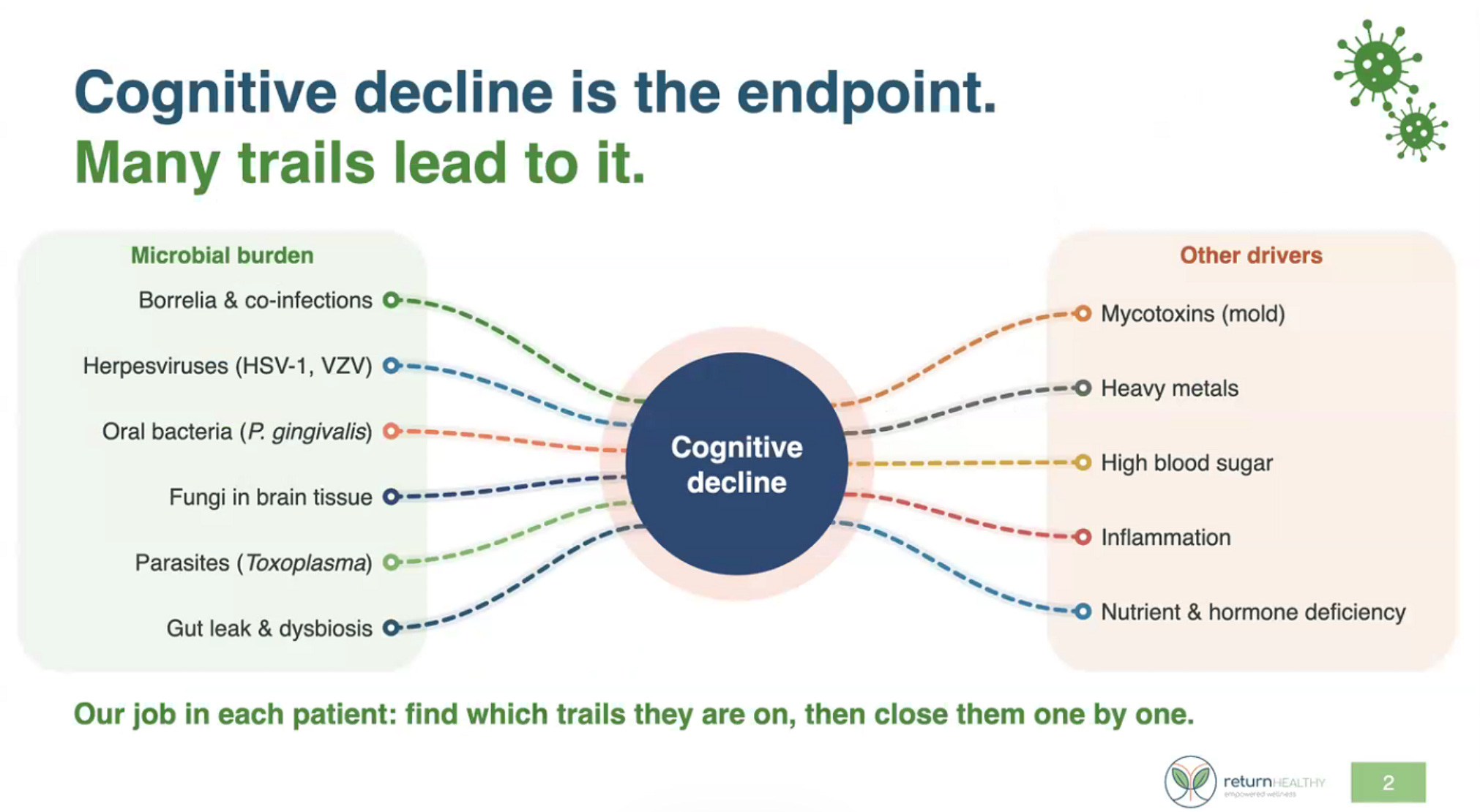
He described looking for a combination of factors that may include tick-borne infections, dental bacteria, digestive tract dysbiosis, herpes viruses, mold exposure and other inflammatory or toxic influences. His clinical approach is built around determining which of those factors are active, which are obstacles to progress, and what needs to happen first.
That sequencing became one of the most useful parts of the discussion.
A patient may have a compelling infectious picture, for example, but still have poor elimination, sluggish bile flow, constipation or significant inflammatory reactivity. In that situation, Vosloo does not necessarily begin by aggressively targeting the infection.
He first asks whether the patient has a way to eliminate what is being mobilized.
For the complex patients in his practice, his sequence often begins with reliable daily elimination, followed by binders and support for bile flow and gastrointestinal function. From there, he works toward supporting phase two detoxification before increasing phase one activity. Antimicrobial strategies come later, depending on the patient and the clinical picture.
That is a very different clinical conversation from simply asking, “What should I give for Lyme?”
It also explains why he emphasized that treatment has to be individualized. One patient may tolerate several interventions at once. Another may be older, more fragile or highly reactive and need one change at a time, with several days between introductions.
The goal is to know what the patient can actually respond to.
Vosloo also challenged the idea that the absence of a classic Lyme history should not automatically end the investigation. He discussed patients with cognitive decline who have no remembered tick bite or classic rash, while presenting with other clinical findings that raise suspicion for tick-borne illness.
His position was straightforward: history is useful, but the clinical presentation deserves a much closer look.
He also described the challenge of patients dealing with multiple environmental and infectious exposures at the same time. In his experience, mold exposure and tick-borne illness can create competing obstacles to progress, particularly when inflammation, impaired bile flow and poor elimination are already present.
The important clinical question becomes one of prioritization.
Which problem is currently preventing the patient from moving forward?
That same thinking carried into his discussion of antimicrobial treatment. Vosloo described using herbal formulas with different intended roles, including broad antimicrobial activity, intracellular pathogens and inflammatory regulation. He also discussed biofilm strategies and why he prefers to have elimination and antimicrobial support established before deliberately disrupting biofilms.
His concern was practical: opening up a biofilm can potentially increase the amount of material that needs to be handled. The patient needs enough support in place to deal with what is released.
For clinicians working with complex cognitive cases, this kind of sequencing changes how you interpret treatment reactions.
A patient who feels significantly worse after an intervention may not simply be “detoxing.” The response itself can provide information about tolerance, inflammatory burden, elimination capacity and what the patient is currently capable of handling.
The conversation eventually moved from clearing obstacles to rebuilding.
Vosloo described phospholipids, butyrate and other nutritional strategies as part of a longer-term effort to support neurologic structures and cellular function. His focus was on providing the structural components needed for membranes and supporting the gut-brain relationship after the inflammatory and microbial burden has been addressed.
He repeatedly returned to the same underlying idea: structure supports function.
That perspective also explains why his approach does not stop at identifying a pathogen.
A positive test can tell you something important. It does not necessarily tell you what the patient needs first, how much they can tolerate, or which other systems are preventing them from responding.
Those are clinical judgment questions.
And they were exactly the kinds of questions the Mastermind kept coming back to throughout the session.
There was also a particularly useful discussion around what to do when testing is negative but clinical suspicion remains high. Vosloo acknowledged the limitations of relying on any single diagnostic result and described situations in which he continues to consider the broader clinical picture.
For clinicians treating cognitive decline, that is where the work gets interesting. The challenge is rarely a lack of available tests or interventions. It is deciding what the findings mean together and how to sequence care without overwhelming an already compromised patient.
This week’s Mastermind gave members a window into how an experienced clinician approaches that problem in practice.
And there was considerably more to the conversation than could fit here, particularly around intracellular pathogens, antimicrobial resistance, biofilms, detoxification pathways and the use of phospholipids in neurologic care.
Those are the conversations we’ll continue to have inside the TruNeura Mastermind.
Interested in learning how the TruNeura Methodology approaches complex cognitive decline cases? Book a call to explore joining the TruNeura Mastermind.

