

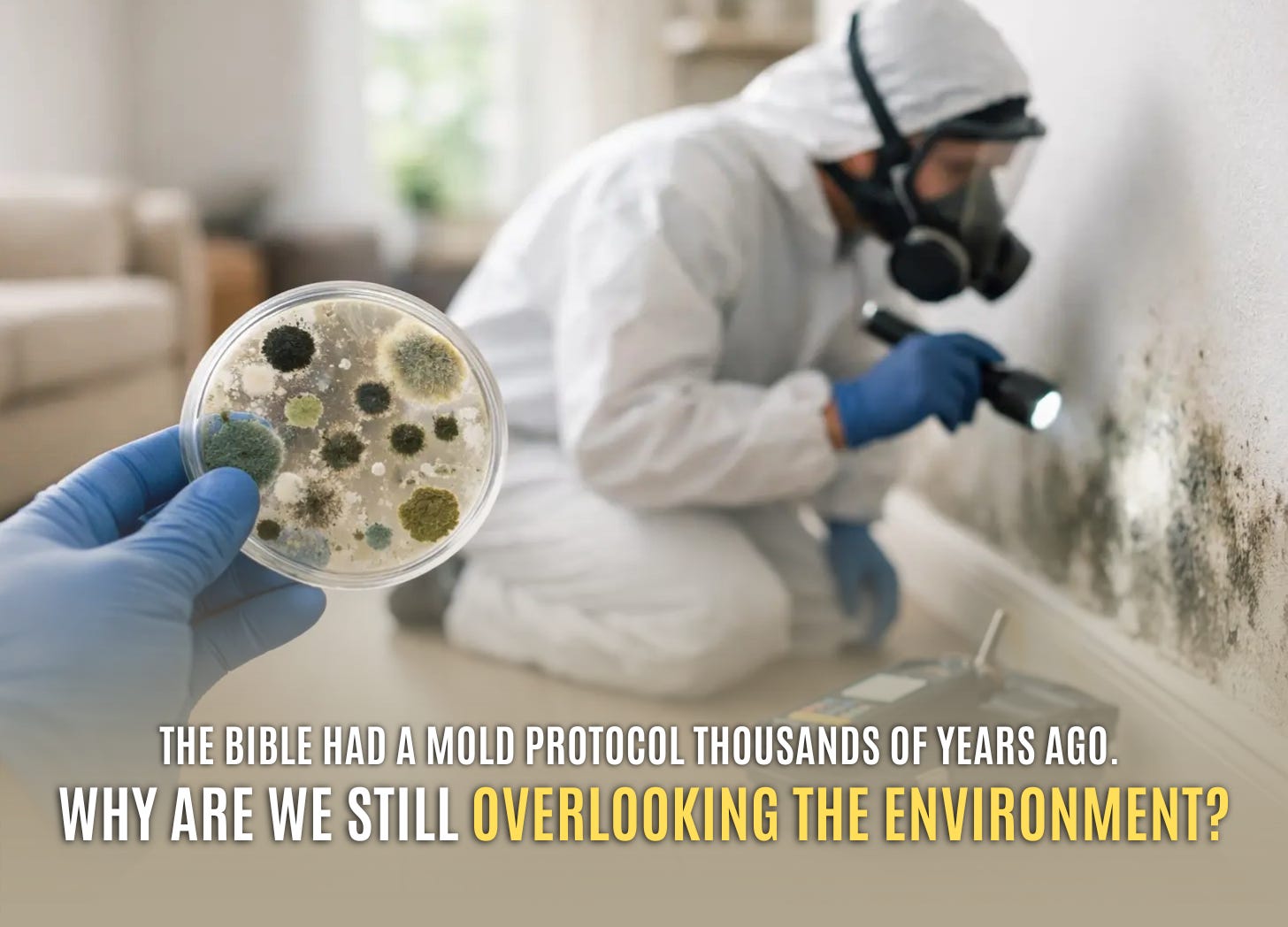
One of the interesting things that happens when doctors start practicing precision brain medicine is that they begin to see patterns they weren’t necessarily looking for.
They start with a patient experiencing cognitive decline. They investigate the metabolic factors, the vascular issues, the inflammatory markers, the nutritional deficiencies. And somewhere along the way, they discover that the patient has been living or working in a water-damaged building.
For many clinicians, it’s surprising how often mold and other environmental exposures enter the conversation.
Of course, the relationship between mold exposure and cognitive decline is still an evolving area of research. We have good evidence connecting damp and moldy buildings with respiratory and allergic illness, but the evidence linking indoor mold directly to Alzheimer’s disease is much less established.
Still, it raises an important question. If we’re trying to understand what’s driving a person’s health problems, shouldn’t we be interested in the environment they’re living in?
And here’s where the story gets interesting.
It turns out humans have been wrestling with this question for thousands of years.
In fact, there’s a remarkably detailed description of how to deal with a contaminated house in the Bible.
The Mold Protocol in Leviticus
In Leviticus 14, we find instructions for dealing with what the King James Bible calls a “plague” in a house.
The original Hebrew term is tsara’at, which has traditionally been associated with leprosy. But when the term is applied to buildings, some scholars have suggested that it may describe mold, mildew, or another form of spreading contamination.
We can’t know exactly what the ancient writers were observing. What we can say is that they had developed a systematic approach to investigating and dealing with something spreading through the walls of a home.
Here’s how the passage begins:
Leviticus 14:35–38 (King James Version)
“And he that owneth the house shall come and tell the priest, saying, It seemeth to me there is as it were a plague in the house:
Then the priest shall command that they empty the house, before the priest go into it to see the plague, that all that is in the house be not made unclean: and afterward the priest shall go in to see the house:
And he shall look on the plague, and, behold, if the plague be in the walls of the house with hollow strakes, greenish or reddish, which in sight are lower than the wall;
Then the priest shall go out of the house to the door of the house, and shut up the house seven days:”
The instructions continue with an inspection after seven days. If the condition has spread, the affected stones are removed, the walls are scraped, and the contaminated material is taken outside the city.
Leviticus 14:40–42
“Then the priest shall command that they take away the stones in which the plague is, and they shall cast them into an unclean place without the city:
And he shall cause the house to be scraped within round about, and they shall pour out the dust that they scrape off without the city into an unclean place:
And they shall take other stones, and put them in the place of those stones; and he shall take other mortar, and shall plaster the house.”
And if the problem returns after those repairs, the instructions become considerably more drastic.
Leviticus 14:45
“And he shall break down the house, the stones of it, and the timber thereof, and all the mortar of the house; and he shall carry them forth out of the city into an unclean place.”
Think about that for a moment.
Thousands of years before anyone understood microbiology, there was a written protocol for inspecting a building, isolating a potential problem, removing affected materials, and escalating the intervention if the problem returned.
It wasn’t modern mold science. It was a religious and ritual framework for dealing with impurity. But the practical parallels are fascinating.
From Leviticus to the EPA
What makes this particularly interesting is how much of the underlying logic remains recognizable in modern mold remediation.
The US Environmental Protection Agency has published guidance for dealing with mold and moisture in buildings. Its central message is that mold remediation requires more than simply cleaning up what’s visible. You also have to deal with the moisture problem that allowed the mold to grow in the first place.
Compare the two approaches.
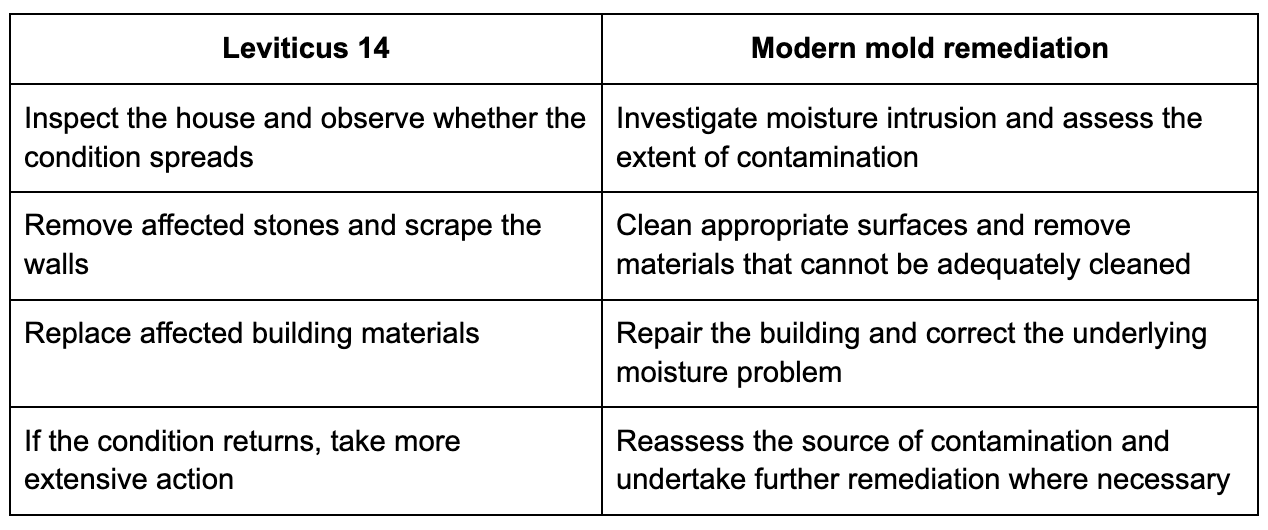
The ancient instructions go as far as demolishing the house if the problem persists. Modern guidance is more nuanced, of course. Demolition is not a standard response to recurring mold, and remediation decisions depend on the extent of damage and the materials involved.
But there’s a common principle running through both approaches.
If the problem is in the building, you have to address the building.
This isn’t a connection we’ve invented at TruNeura. Researchers have been writing about it for decades.
In 2003, Richard Heller, Toni Heller, and Jack Sasson published a paper in Perspectives in Biology and Medicine titled Mold: “tsara’at,” Leviticus, and the History of a Confusion, examining the historical interpretation of the biblical passage and its relationship to mold.
The parallel has also appeared in discussions of building safety and environmental remediation.
What interests me is what happens when we bring that conversation into modern brain medicine.
What This Means for Brain Health
One of the foundational ideas behind the TruNeura methodology is that the brain doesn’t exist in isolation.
When we’re dealing with cognitive decline, we have to understand the network of factors influencing brain function.
Some of those factors are inside the body. Metabolic dysfunction, vascular insufficiency, inflammation, nutritional status, hormonal changes, and many others.
Some are behavioral and social. Sleep, movement, stress, relationships, and the communities people belong to.
And some are environmental.
That last category is particularly interesting because it can be easy to overlook in a conventional medical appointment.
A patient might spend years receiving treatment for symptoms without anyone asking whether there has been water damage in their home, whether their workplace has ongoing moisture problems, or whether their symptoms change when they spend time away from a particular building.
Those questions don’t establish a diagnosis. But when there’s a credible history of exposure, they’re worth asking.
In the TruNeura clinician mastermind, practitioners have been sharing the Leviticus passage as a way to introduce this conversation to patients.
I love that.
Not because we’re suggesting that the Bible provides a modern clinical protocol, but because it helps people understand that concern about the health of our buildings isn’t some strange new idea that emerged with functional medicine.
It’s something humans have been thinking about for generations upon generations.
And for a patient who is hearing about environmental exposures for the first time, that historical context can be surprisingly useful.
Sometimes the First Intervention Is Removing Something
There’s a tendency in modern medicine, and certainly in the world of longevity and precision health, to focus on what we can add.
Another supplement. Another medication. Another technology. Another intervention.
And many of those tools can be incredibly valuable.
But one of the important principles in a comprehensive precision medicine approach is identifying things that may be getting in the way of recovery.
If someone has a significant, ongoing environmental exposure, it makes sense to address that exposure rather than focusing exclusively on what we can add to their treatment plan.
That doesn’t mean every patient with cognitive decline has a mold problem. It doesn’t mean that remediating a building will reverse Alzheimer’s disease. We need to be careful not to make claims that science hasn’t established.
What it does mean is that a serious approach to understanding health should include the environment, especially when the patient’s history gives us reason to investigate it.
And this is part of a bigger shift I believe we’re seeing in medicine.
We’re moving from a model that focuses primarily on treating diseases after they appear toward one that attempts to understand the conditions in which health and disease emerge.
That requires a much broader lens.
An Ancient Lesson for the Brain Medicine Revolution
I find it extraordinary that a passage written thousands of years ago can still offer such a useful starting point for a conversation about environmental health.
The people who wrote Leviticus didn’t know about fungal species, mycotoxins, inflammatory biomarkers, or the complex biology of neurodegeneration.
But they understood that a problem in a house could require more than a superficial response.
Today, we have environmental testing, building science, advanced laboratory analysis, and a far more sophisticated understanding of human physiology.
We also have an opportunity to connect those disciplines in ways that conventional medicine has historically struggled to do.
For me, that’s part of what the precision brain medicine revolution is about.
Not simply developing better treatments for the brain, but getting better at understanding all the conditions that influence brain health.
And sometimes that means looking at the walls around us.
References and Further Reading
The Bible, Leviticus 14:35–45. King James Version. Read the full passage.
Heller RM, Heller TW, Sasson JM. Mold: “tsara’at,” Leviticus, and the History of a Confusion. Perspectives in Biology and Medicine. 2003. PubMed.
US Environmental Protection Agency. A Brief Guide to Mold, Moisture and Your Home. EPA guidance.
World Health Organization. WHO Guidelines for Indoor Air Quality: Dampness and Mould. 2009. WHO publication.
Centers for Disease Control and Prevention. Mold: Health Problems. CDC mold information.
TruNeura supports clinicians implementing comprehensive, personalized approaches to brain health through advanced biomarker interpretation, clinical education, and collaborative care.


Love it! Ancient wisdom meeting modern science is my jam.
Excellent post!! Thank you.
" ... getting better at understanding all the conditions that influence brain health." So important, and with all conditions.