

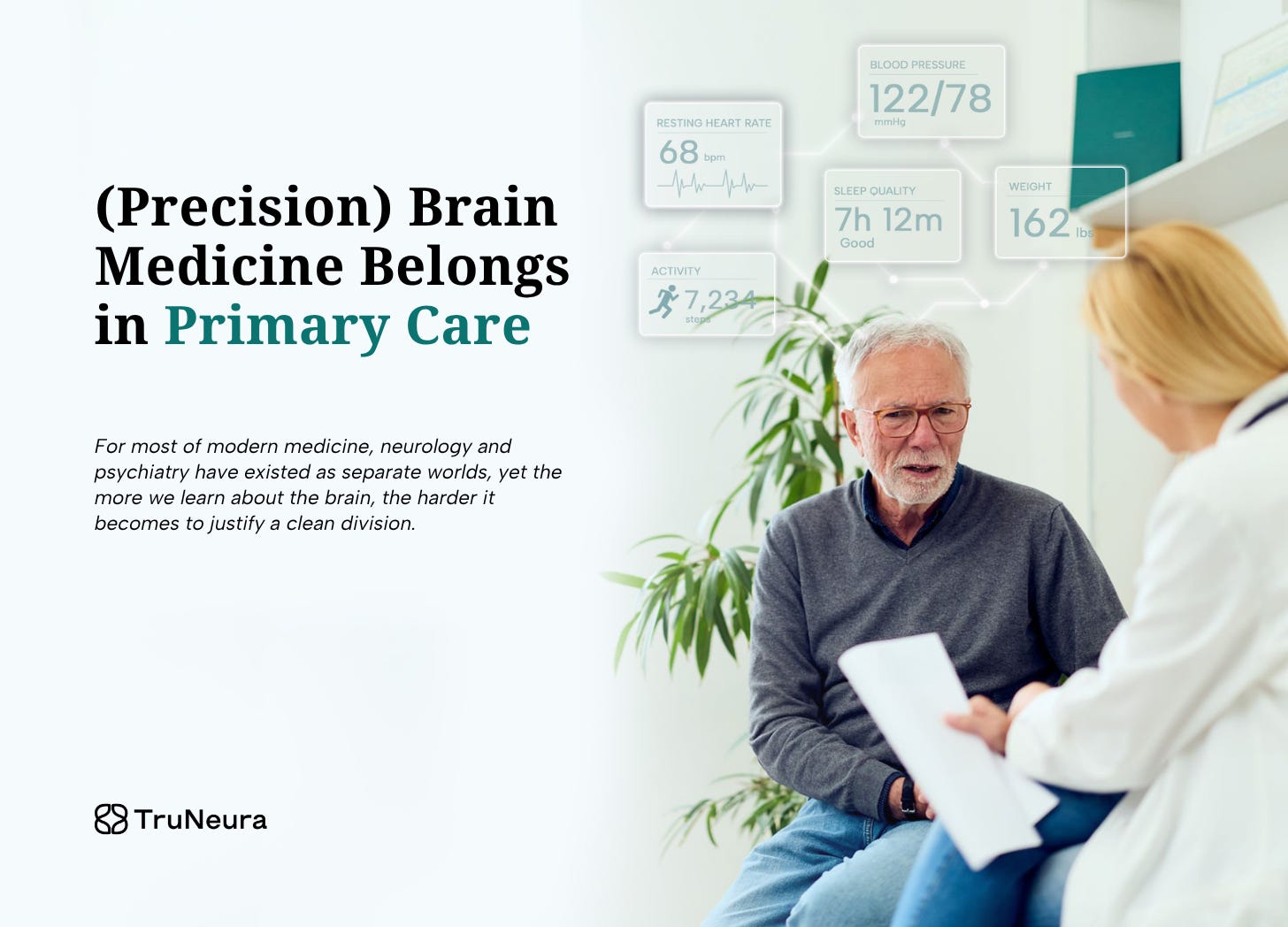
For most of modern medicine, neurology and psychiatry have existed as separate worlds. Neurologists treated diseases of the brain, while psychiatrists treated disorders of the mind. They developed different training programs, professional societies, diagnostic frameworks and therapeutic approaches. Yet the more we learn about the brain, the harder it becomes to justify such a clean division.

That is why I was interested to see a recent Forbes article by Naveen Rao about Radial’s acquisition of Mindful Health Solutions framed around the emergence of a broader category: brain medicine. The transaction itself is interesting, but I think the terminology is the bigger story. Neurology and psychiatry are beginning to converge around the understanding that many of the conditions they treat are manifestations of the same extraordinarily complex biological system.
The question, however, is not simply whether neurology and psychiatry become brain medicine. The much more consequential question is where this new discipline should live. If brain medicine becomes another specialist category that patients enter only after significant neurological or psychiatric symptoms appear, we will have recreated one of the biggest problems with the current system. In my view, brain medicine ultimately has to move upstream into primary care.
The Artificial Divide Between Neurology and Psychiatry
The historical distinction between neurological and psychiatric disease makes increasingly less sense when viewed through the lens of modern biology. Depression, anxiety, cognitive impairment, Alzheimer’s disease, traumatic brain injury and many other conditions may receive different diagnostic labels, but they share overlapping biological terrain. Sleep, metabolic health, vascular function, inflammation, hormones, environmental exposures, nutrition, exercise, stress and social connection can all influence how the brain functions.
At the same time, psychiatry is becoming increasingly neurological. Brain imaging, EEG, TMS, neuromodulation and other technologies are giving clinicians new ways to measure and influence brain function rather than relying exclusively on symptoms and clinical observation. Neurology is moving in a complementary direction as we increasingly recognize that neurological diseases cannot always be understood simply by identifying a lesion, a protein or a diagnosis. Brain function emerges from networks, and those networks are influenced by what is happening throughout the rest of the body.
Ultimately, the brain does not know whether the doctor treating it has the word “neurologist” or “psychiatrist” on the door. These specialties are approaching the same organ from different historical directions, and increasingly they are meeting in the middle. Brain medicine is a useful way of describing that convergence.
The Neurologist Cannot Be the Starting Line
The problem is that our current neurological system is largely designed to intervene after something has already gone wrong. This is particularly obvious with cognitive decline. A patient notices memory problems, or more commonly their spouse or children notice them. Eventually the issue is raised with a primary care physician. Testing begins, referrals are made and, at some point, the patient arrives at the neurologist.
The neurologist is essential at that stage, but from the perspective of prevention and changing the long-term trajectory of disease, we may have missed years of opportunity. The biological processes associated with Alzheimer’s disease can begin many years before someone receives a diagnosis of dementia. Metabolic dysfunction, vascular disease, poor sleep, physical inactivity, hearing loss and other modifiable risk factors can accumulate over decades.
Cardiovascular medicine offers an obvious comparison. We do not wait until someone has a heart attack before becoming interested in their cardiovascular system. Primary care routinely measures blood pressure, lipids, glucose and other indicators because we understand that cardiovascular disease develops over time. We identify risk and intervene long before the cardiologist or cardiac surgeon is needed.
We need to start thinking about the brain in the same way.
Primary Care Needs an Early-Warning System for the Brain
There is an important practical problem with that vision. We cannot simply tell primary care clinicians to start treating brain health earlier. We have to give them a system that tells them when the process of brain dysfunction has begun.
This is where some of the most exciting developments in brain medicine are happening.
New blood biomarkers, including phosphorylated tau assays such as p-tau217, are creating the possibility of identifying Alzheimer’s-related pathology through a blood draw. As these technologies mature and become integrated into clinical practice, they have the potential to fundamentally change where and when conversations about cognitive health begin.
Instead of waiting for obvious cognitive impairment followed by specialist referral and expensive diagnostic workups, we are moving toward a world in which signals of emerging pathology can potentially be detected much earlier and much closer to primary care.
That is an enormous advance, but it only solves part of the problem.
A biomarker can tell us that a pathological process may be underway. It does not necessarily tell us why this particular person’s brain is becoming dysfunctional, which factors are accelerating that process, or what we can do today to change the trajectory.
That is where precision brain medicine becomes necessary.
Detection Is Only the Beginning
Imagine a 58-year-old patient coming into primary care. Perhaps their p-tau217 begins to suggest Alzheimer’s-related pathology. Perhaps a cognitive assessment has changed from their previous baseline. Perhaps other emerging biomarkers or digital measures identify a concerning trajectory.
That should be an alarm bell, not the end of the investigation.
The next question is: Why?
What is happening with insulin sensitivity and metabolic health? What is happening with vascular function? Is the patient sleeping properly? Is sleep apnea present? What is happening with inflammation? What medications are they taking? What is their nutritional status? Are hormones relevant? What is happening with exercise, hearing, stress and social connection? Are there environmental exposures or other contributors that deserve investigation?
This is where our existing medical architecture struggles. The information necessary to answer these questions is distributed across specialties. One piece belongs to neurology, another to psychiatry, another to endocrinology, another to cardiology, another to sleep medicine and another to primary care.
Yet the patient has one brain.
Precision brain medicine has to bring those pieces together.
Learning Precision Brain Medicine Together
We are already seeing what this looks like inside the TruNeura community. In our TruNeura Mastermind, we have neurologists, psychiatrists, family medicine and primary care clinicians, and functional medicine practitioners learning together. They arrive with very different training and different clinical experiences, but increasingly we are developing a common language around precision brain medicine.
That diversity is important because no single specialty owns everything necessary to understand brain dysfunction.
Neurologists bring deep expertise in neurological disease, diagnosis and pathology. Psychiatrists bring expertise in mood, behavior and psychiatric disease. Primary care and family medicine clinicians understand longitudinal health and are positioned to identify changes years before many patients require specialty care. Functional medicine clinicians bring experience investigating the metabolic, inflammatory, environmental and lifestyle contributors that can drive complex chronic disease.
The opportunity is not to decide which of those groups should own brain medicine. It is to build a system that allows all of them to contribute.
This Is Where TruNeura Is Starting
This is the problem we are focused on at TruNeura.
If precision brain medicine is going to move into primary care, clinicians need more than another test. They need a system that can recognize when brain dysfunction may be emerging, organize the enormous amount of relevant clinical information around that patient, help identify the potential drivers of dysfunction and support the clinical team in developing and following an individualized plan.
The first part of that equation is becoming increasingly possible because of advances in biomarkers such as p-tau217, cognitive testing, imaging and other forms of measurement. The next challenge is understanding the drivers.
That is where we are starting with TruNeura.
We are working to build the clinical infrastructure for understanding the different factors that can contribute to cognitive dysfunction and giving clinicians a systematic way to evaluate them. Rather than seeing Alzheimer’s simply as a diagnosis that eventually arrives in the neurologist’s office, we want clinicians to be able to recognize a changing trajectory earlier, investigate what may be driving it and intervene while there is still meaningful opportunity to influence brain health.
Over time, I believe these two sides of brain medicine will come together. We will have increasingly sophisticated systems for detecting the earliest signals of brain dysfunction, alongside precision medicine systems for understanding and addressing the factors driving that dysfunction.
When that happens, brain medicine will no longer have to begin in the neurologist’s office.
It can begin in primary care.
That may ultimately be the most important implication of the convergence happening between neurology and psychiatry today. We are not simply creating a larger specialty called brain medicine. We have an opportunity to create an entirely different model of brain care, one that starts earlier, measures continuously, understands the individual and brings together expertise from across medicine.
The future of brain medicine is not waiting for disease and then referring to a specialist. It is detecting dysfunction early, understanding what is driving it, and giving primary care the tools to change the trajectory.
That is precision brain medicine.


YES to brain health in primary care.