
Practitioner Spotlight: Enabling Precision Psychiatry


Dr. Jenn Kraker’s work sits at a crossroads where psychiatry, metabolism, and modern systems medicine converge.
Columbia- and Cornell-educated, board certified in Psychiatry and Neurology, and also board certified in Nutrigenomics, Dr. Kraker represents a new generation of psychiatrists who no longer see mental health as separable from the biology of the body. With more than two decades of clinical experience and graduate training in Human Nutrition and the Epigenetics of Mental Health from Columbia University’s College of Physicians and Surgeons, her practice reflects a deeply interdisciplinary approach.
Her patients are often high-functioning individuals who are not satisfied with symptom suppression alone. They are seeking sharper cognition, emotional resilience, sustained energy, and long-term vitality. What Dr. Kraker offers them is precision psychiatry: care grounded in advanced laboratory analysis, genomics, neuroscience, endocrinology, and nutritional biochemistry, woven together into personalized, data-driven treatment plans.
Rather than trial-and-error prescribing, her work is guided by a rigorous premise. When the underlying biochemical and lifestyle drivers are identified and addressed, patients can move beyond coping and toward durable clarity and well-being.
What Sparked Her Commitment to Precision Psychiatry
Dr. Kraker’s passion for this work began early in her medical training, when an uncomfortable reality became impossible to ignore. Nearly 75 percent of chronic Western illness has a behavioral or lifestyle component, yet psychiatry was largely trained to treat mental illness as isolated brain chemistry.
She trained at elite institutions. The education was rigorous and the credentials unquestioned. Still, she found herself increasingly disillusioned with psychopharmacology as it was practiced. Too often, treatment felt like guesswork. Medications were layered. Polypharmacy escalated. Outcomes rarely matched the sophistication of the effort behind them.
Patients were trying. Clinicians were trying. And still, many people were not getting better.
A pivotal influence came earlier in her academic career through her work with Ezra Susser. His landmark research on the Dutch famine showed that women exposed to extreme nutritional stress during pregnancy were far more likely to have children who later developed schizophrenia. The implication was profound. Environment does not simply influence mental health. It can alter gene expression itself.
Epigenetics was no longer theoretical. It was alive.
This insight reshaped how Dr. Kraker viewed the patients in front of her. If acute environmental stress could so powerfully influence mental illness, what about the quieter, chronic forces shaping modern life? Nutrition. Metabolic dysfunction. Inflammation. Hormones. Sleep disruption. Chronic stress.
With advances in genomics and biochemical testing, these factors were no longer invisible. They were measurable signals. When Dr. Kraker began integrating these perspectives into her clinical work, outcomes changed. Patients improved not incrementally, but meaningfully. They felt understood rather than managed.
That shift cemented her commitment to precision psychiatry and to the belief that listening carefully to the body gives the mind a real chance to heal.
A Vision for Scalable, Accountable Mental Health Care
Dr. Kraker believes precision psychiatry is the future of mental health care. Yet today, access remains limited. Advanced diagnostics are expensive. Innovation is siloed. Too much high-quality care depends on individual clinicians rather than systems.
Her vision is to scale precision psychiatry without diluting it.
The next phase of her work focuses on education and training. By teaching other clinicians how to practice data-driven, biologically informed psychiatry, she aims to expand access far beyond what any single practice could deliver. Over time, she envisions regional centers built in collaboration with internal medicine colleagues, where mental and physical health are treated as inseparable.
At the core of this vision are rigor and accountability. Mental health care should be measurable and trackable, held to the same scientific standards as the rest of medicine. Making mental health measurable does not reduce it. It takes it seriously.
Her long-term goal is ambitious and precise: to reach one million minds through systems that make better care possible at scale.
Why TruNeura Became Part of Her Clinical Ecosystem
What initially drew Dr. Kraker to TruNeura was its focus on cognitive decline. But what ultimately resonated was the deeper premise behind the platform.
The brain is the brain, and the body informs the brain.
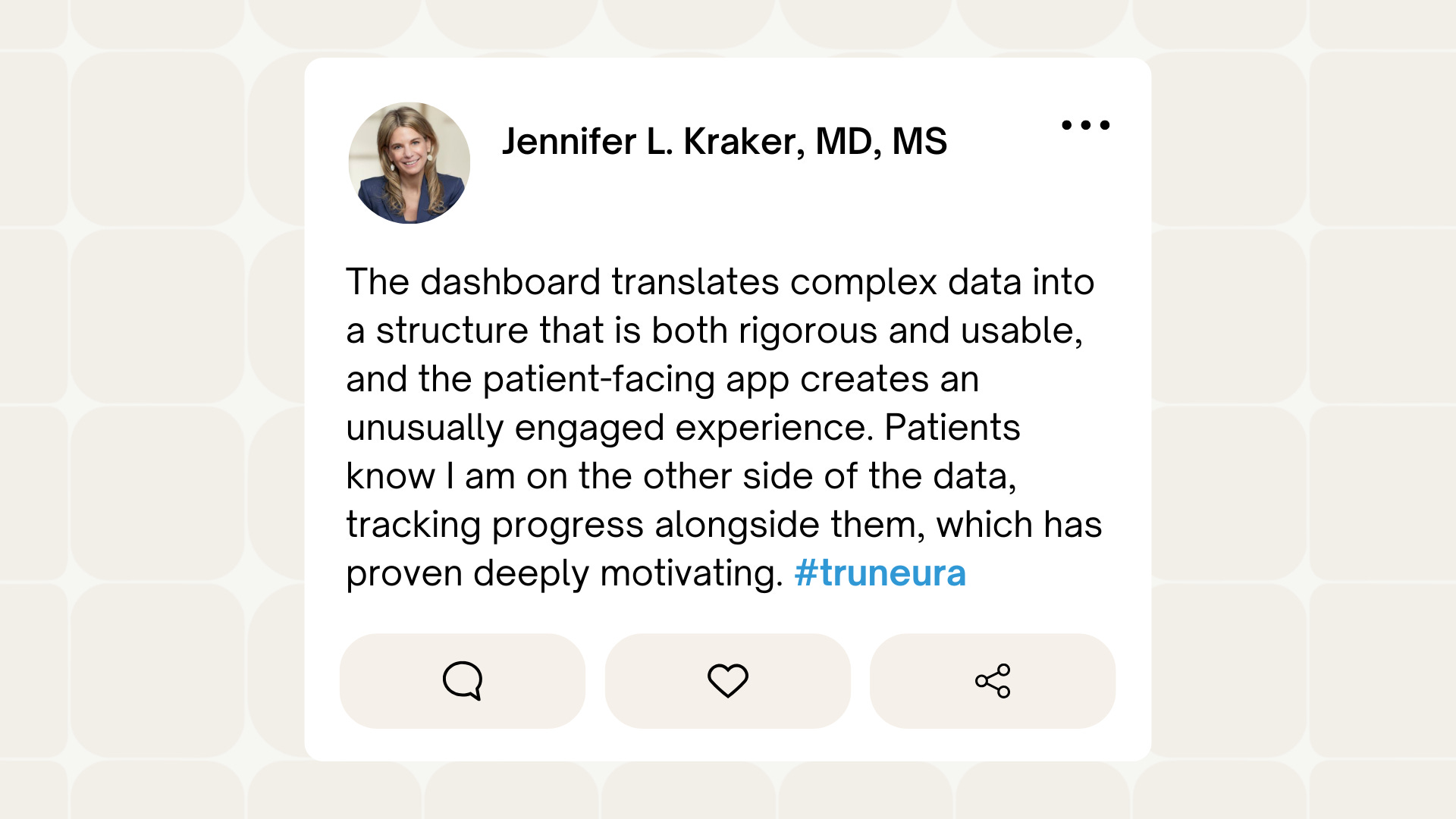
A system built to understand neurodegeneration, when done well, naturally extends across the entire spectrum of mental health. TruNeura stood out for its clinical clarity. The dashboard translates complex data into a structure that is rigorous, usable, and teachable. Metrics are organized, scored, and contextualized in a way that supports both clinical judgment and education.
From the patient side, the experience is equally important. Patients know their data is being actively tracked. They feel accompanied rather than observed. That sense of shared engagement has proven deeply motivating.
For Dr. Kraker, this matters not only for patient outcomes, but for the future of training. Advanced lab interpretation and genomic integration are rarely taught in conventional medical education. Much of this knowledge has historically lived inside individual clinicians. TruNeura externalizes and operationalizes it, making precision psychiatry scalable rather than artisanal.
The TruNeura Mastermind added another dimension. It brought together a community of clinicians who are curious, generous, and collaborative. Through this group, Dr. Kraker has expanded her work into the prevention and slowing of cognitive decline, an area she sees as increasingly urgent.
Strong tools combined with a strong community have made TruNeura more than a platform. For her, it has become an ecosystem for building the future of precision psychiatry.

Can you make add a share button to social media? Please see the video below true story from 2005, 2015 books and 2015 movie of Sally Pacholok ignored in mainstream healthcare for years on B12, for why we need a paradigm chamge to imitate TruNeura.
Please help get advocacy leaders united to demand a Standard of Care and Ethics to REQUIRE tests of brain disorder patients for proven upstream treatable causes? 1. Brain nitrients 2. Toxins 3. Infections
https://youtube.com/playlist?list=PLkScFRcnM8K90GWzoBzIoFCfdAMlCr22O&si=UBfxEvPNPrsBv3h0