

For decades, the Alzheimer’s field has been dominated by a singular focus: removing amyloid plaques from the brain. Drug companies have poured billions of dollars and decades of time into anti-amyloid therapies, producing four FDA-approved Alzheimer’s drugs. Yet the outcomes are underwhelming. These drugs modestly slow progression but do not halt or reverse the disease. Meanwhile, the annual cost of these medications often exceeds $20,000 per patient, placing a heavy financial burden on families and health systems.
Now, emerging research is shining light on an overlooked, inexpensive compound that could change the game: lithium orotate.
Lithium, Amyloid, and the Antimicrobial Hypothesis
Alzheimer’s pioneer Dr. Rudy Tanzi and the late Dr. Robert Moir advanced a controversial but increasingly supported idea: amyloid is not a random toxin, but an immune protectant. In early stages, amyloid plaques may serve as an antimicrobial defense, trapping pathogens in the brain. The problem arises when this immune response spirals out of control.
Interestingly, lithium, amyloid, and even selective serotonin reuptake inhibitors (like Prozac) share antimicrobial activity. This suggests that the biology of Alzheimer’s may be intimately linked with infection, immunity, and microbial balance, not just the accumulation of “toxic waste.”
Lithium in the Brain: A Missing Nutrient?
Lithium is best known as a psychiatric drug, but in fact, it is a trace mineral naturally present in the brain. Recent studies from Rush University’s Memory and Aging Project revealed that brain donors with mild cognitive impairment or Alzheimer’s had significantly lower lithium levels compared to cognitively healthy individuals.
Animal studies back this up. Mice deprived of lithium showed:
Faster memory loss
Greater synaptic decline
Accelerated amyloid plaque formation
At the same time, amyloid plaques were found to bind lithium, reducing its availability for vital immune and repair functions. Microglia—the brain’s “janitorial” cells—were impaired under lithium-deficient conditions, unable to clear plaques effectively.
In short: low lithium may be both a marker and a driver of Alzheimer’s pathology.
Why Lithium Carbonate Falls Short
Lithium carbonate has been used for decades in psychiatry to treat bipolar disorder. Some observational studies suggest lower dementia rates in bipolar patients treated with lithium, hinting at neuroprotective effects.
But there’s a problem:
Lithium carbonate is bound by amyloid plaques, reducing its effectiveness in Alzheimer’s.
The doses required to overcome this are toxic in older adults, leading to kidney and thyroid issues.
That’s why attempts to repurpose lithium carbonate for dementia have stalled.
The Lithium Orotate Discovery
A September 2025 NIH-highlighted study led by Dr. Bruce Yanker at Harvard took a different approach. Researchers compared different lithium compounds and found that:
Lithium orotate, unlike lithium carbonate, does not bind to amyloid plaques.
It remains available to the brain even in amyloid-rich conditions.
It works at doses one-thousandth of those used for lithium carbonate, dramatically lowering toxicity risks.
In mouse models, lithium orotate reversed memory loss, prevented brain cell damage, and slowed Alzheimer’s progression—without adverse effects.
Since lithium orotate is already sold as a nutritional supplement, the implications are profound.
Why Haven’t We Tried This Already?
The simple answer: MONEY.
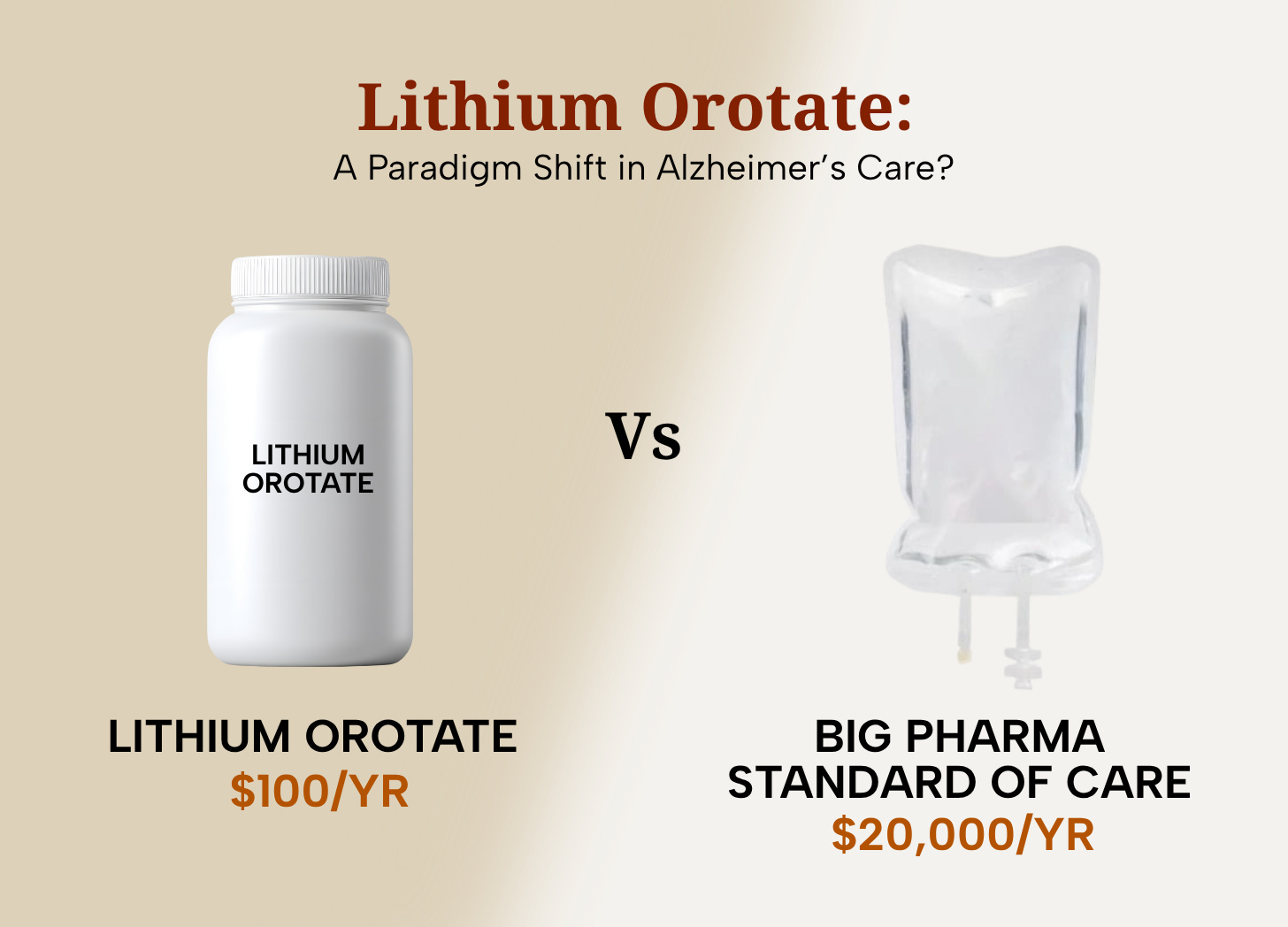
Pharmaceutical companies invest in clinical trials only when there is a potential for large profits. Nutritional supplements like lithium orotate (being inexpensive and already widely available) don’t fit that model.
As a result, potentially transformative therapies languish in obscurity while costly drugs with marginal benefit dominate the market.
A New Model for Alzheimer’s Trials
What if we flipped the script? Instead of waiting decades for large, pharma-funded randomized controlled trials (RCTs), communities and clinicians could organize fast, decentralized trials themselves.
Here’s one vision:
Recruit patients with mild to moderate dementia via social media and practitioner networks.
Provide 10 months of lithium orotate for $100.
Use local clinicians to track safety, cognition, and function.
Compare outcomes against the well-known trajectory of untreated dementia.
If results are promising, lithium carbonate could be tested as a backup in non-responders. Within one year, we would have actionable insights, without waiting decades. TruNeura intends to be a clinical implementation software layer that can organize this kind of effort in a way that tracks the outcomes via a range of outputs.
Beyond Mice: Human Relevance First
A final frustration in Alzheimer’s research: mice do not naturally get Alzheimer’s. Yet billions are still spent on rodent models that often fail to translate to humans.
Lithium orotate offers a chance to test a safe, inexpensive intervention directly in patients, where it matters most.
The Paradigm Shift We Need
Lithium orotate is not a silver bullet. But it represents exactly the kind of low-cost, systems-based intervention that could transform the Alzheimer’s landscape if tested properly.
At TruNeura, we believe the future of brain health lies not in billion-dollar drugs with modest benefit, but in precision, community-driven, affordable solutions that work with the body’s own repair systems.
This is a call to action:
Researchers: Step outside the pharmaceutical box. Explore lithium orotate and other under-researched compounds.
Clinicians: Be part of decentralized trial networks. Patients need options now, not decades from now.
Funders: Support bold, low-cost innovations with the potential to save millions of lives and billions of dollars.
Conclusion
Lithium orotate is inexpensive, naturally occurring, and—if early evidence holds up—more effective and safer than existing Alzheimer’s drugs. Yet it will only move forward if we build new pathways for research and validation outside the pharmaceutical status quo.
The Alzheimer’s crisis demands urgency. We cannot afford to waste another 30 years chasing the wrong targets. It’s time for a paradigm shift, one that embraces low-cost, accessible, and biologically rational therapies like lithium orotate.
Want to be part of the paradigm shift in cognitive decline? TruNeura is building a network of clinicians and innovators committed to reversing brain health decline.
👉 Book a TruNeura Demo to learn more.
I have a strong family history of Alzheimer's disease (mother, grandmother). At 77, my memory isn't as good as it was decades ago, although for my age, I think my brain works pretty well. One reason might be that for decades I've taken lithium orotate 5 mg at bedtime as a sleep aid. Based on the recent research, I've upped the dose to 50 mg daily. I also added methylene blue as a brain enhancer, and I completely gave up alcohol because it's a neurotoxin. So far, so good.
Most lithium orotate bottles on Amazon have labels ~ “100 mg lithium orotate/5 mg lithium”. Would the Chile trial use half a tablet or 10 tablets daily?