

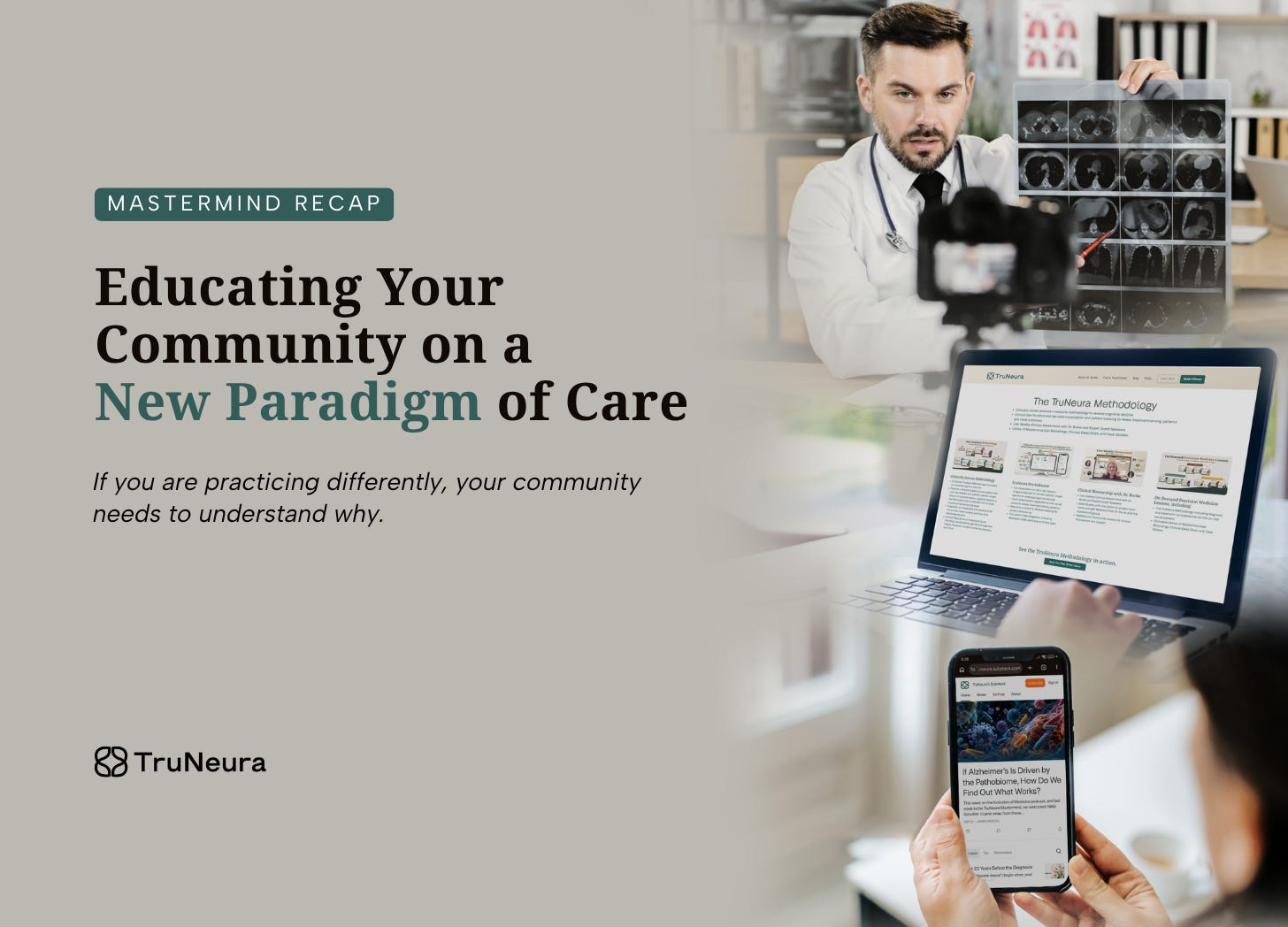
Many clinicians are practicing within a different paradigm than the one most patients have encountered.
They may be looking at root causes rather than symptoms alone. They may approach cognitive decline differently, think about metabolic health in a broader context, or use a more individualized approach to assessment and treatment.
The clinician understands the difference.
The patient often does not.
That creates an interesting communication problem. You can have an excellent clinical methodology, but if you only talk about individual diagnoses, symptoms or general health information online, prospective patients may never understand what actually makes your practice different.
This week’s TruNeura Mastermind discussion with Uli Iserloh, founder and CEO of Big Boost Marketing, focused on building a content system around that problem.
The starting point is surprisingly simple:
What do you want your community to understand?
1. Get clear on what you want to educate people about
Before creating reels, carousels or social posts, a clinician needs to decide what ideas they want to consistently teach.
That might mean explaining the root causes you see behind a particular condition.
It might mean teaching patients about signals they have been told are normal.
It might mean explaining your diagnostic process or the methodology you use in your practice.
Or it could mean helping people understand why the way you approach a familiar condition differs from what they have experienced elsewhere.
During the session, Uli talked about organizing these ideas into a larger content architecture rather than choosing topics randomly.
One example was building a library of core ideas around concepts such as reframing the problem, identifying underlying root causes, recognizing signals patients tend to normalize, and explaining a signature methodology.
This gives the clinician something much more useful than a list of social media topics.
It creates a body of education.
Think about what happens when someone follows your practice for six months.
What do you want them to understand that they did not understand before?
What language do you want them to recognize?
What questions should they start asking?
What should they understand about your approach before they ever schedule a discovery call?
Those answers become the foundation.
2. Create the assets
Once those core ideas are clear, they can be turned into different forms of content.
This is where many clinicians make social media much harder than it needs to be.
They sit down and ask, “What should I post today?”
Instead, start with one important clinical idea.
That idea could become a short video. It could become a carousel. It could become an infographic. It could become an FAQ on the website, an email, a Substack article or a patient education resource.
Uli described a system built around a relatively small number of core ideas that can generate a much larger library of content.
For example, 30 core concepts can become captions, reel scripts, image posts and other assets. Those pieces can then be distributed across multiple platforms.
The clinician does not need to personally sit down and create every version.
The important part is that the underlying idea comes from the practice.
That is especially important when using AI.
AI can create a polished post about almost anything. But generic content does little to communicate your particular clinical thinking.
The more information AI has about your practice, your patients, your methodology, your expertise and the problems you are trying to solve, the more useful it becomes as part of the content process.
The expertise still comes from the clinician.
3. Repeat the ideas
This may be the part that feels least natural to clinicians.
We are trained to keep moving forward. Once we have explained something, we assume people have heard it.
Social media does not work that way.
Most people will not see the first post.
They may see the fifth.
Someone else may encounter the idea six months later.
And even if the same person sees it several times, repetition can help them understand a concept that was unfamiliar the first time.
One clinician in the Mastermind shared a system in which core content was scheduled and repeated over long periods. Some of the posts reached hundreds of thousands of views.
His point was that consistency was a major part of the result.
Uli also discussed repeating core content rather than assuming every post needs to be completely new.
That is important for clinicians because the pressure to constantly produce new material is one of the fastest ways to make social media exhausting.
You do not need to reinvent your message every week.
If something is central to how you practice, people should probably hear it more than once.
Your content becomes part of the education
There is another reason this matters.
Patients are trying to make sense of their health long before they contact your practice.
They are searching. They are watching videos. They are reading posts. They are asking questions in online communities.
For someone dealing with cognitive decline, for example, there may be years of uncertainty before they ever schedule with a clinician.
What are the early signs?
What is actually causing the problem?
What should we be looking at?
Is there anything that can be done?
Those questions are opportunities to educate.
A practice that consistently teaches its way of thinking can begin answering those questions before the patient ever becomes a lead.
One TruNeura Mastermind member shared that patients who had consumed the practice’s content often arrived already familiar with its methodology. The initial conversation could start from a different place because some of the education had already happened.
That is a very different purpose for social media than simply keeping an account active.
Build the library once. Keep teaching it.
The most useful shift may be to stop thinking about social media as a stream of new posts.
Think of it as a library of education.
What are the 20, 30, 50 or 80 ideas your community needs to understand if they are going to understand your practice?
Once those are identified, you can build the assets.
Then you repeat them.
You can add new ideas over time, but your core educational message remains visible.
For clinicians building a practice around a new paradigm of care, that consistency matters. People cannot understand a methodology they have only encountered once.
They need to see it, hear it, encounter different examples of it and gradually become familiar with the way you think.
That is how clinical expertise becomes something your community can actually recognize.
The end result is more of the right patients finding you. Some TruNeura members are seeing so much demand that they can’t keep up with it!
Want help building this for your practice? Book a Strategic Content Audit with Uli and the Big Boost Marketing team. They can review your current website and social media and identify opportunities to build a stronger educational content strategy.

