
Does Reversing Cognitive Decline Make You Agitated?

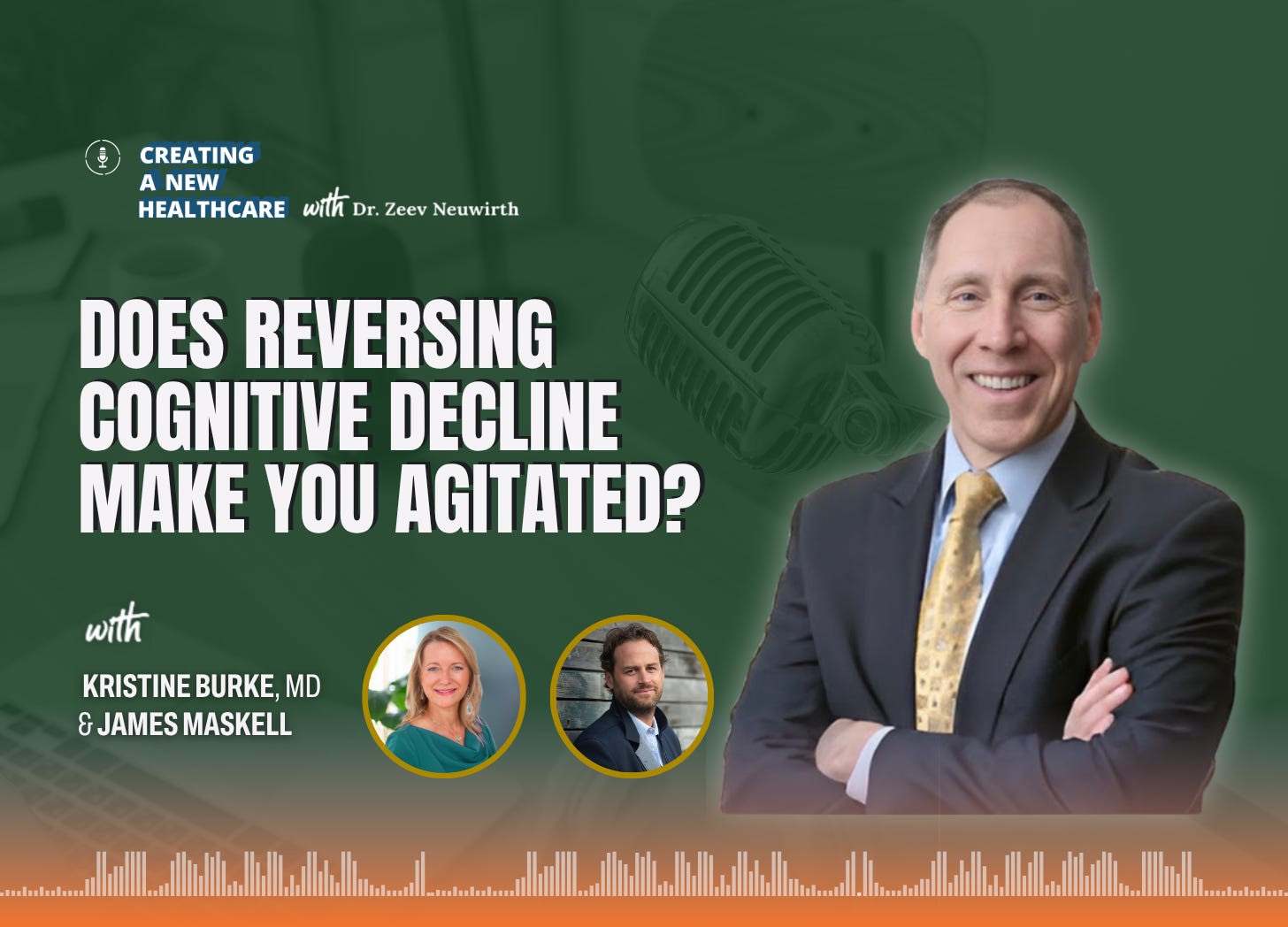
Dr. Kristine Burke and I were recently featured on the Creating a New Healthcare podcast with Zeev Neuwirth, a physician who has not only spent the last decade interviewing many of the leading voices shaping the future of medicine on his podcast but also served as Chief Transformation Officer at Atrium Health, a billion dollar healthcare system based in North Carolina. Two years ago I had read his book “Beyond The Walls” which alerted me to his deep understanding that a push towards lifestyle focused care was a necessary shift, and it was mainly happening outside hospital walls.
What made this conversation so striking was not just the science. It was hearing someone with that level of experience openly admit that there were major drivers of cognitive decline he had never been taught to look for.
About eleven minutes into the episode, Dr. Neuwirth pauses and says something that perfectly captures the moment we are living through in medicine right now.
He says he feels agitated.
Agitated because he realizes there are drivers of cognitive decline that were simply never part of his medical training. You can hear the genuine frustration in his voice as he processes the idea that millions of patients have been treated inside a system that largely viewed cognitive decline as inevitable, rather than something with identifiable and modifiable causes.
That moment matters because Dr. Neuwirth represents the mainstream of medicine at its highest level. He is thoughtful, accomplished, deeply experienced, and genuinely committed to improving healthcare. If someone with that background is only now realizing the extent to which cognitive decline may be driven by inflammation, metabolic dysfunction, sleep disruption, environmental toxins, vascular issues, nutrient deficiencies, loneliness, infections, and lifestyle factors, then it says something important about where medicine is right now.
For decades, patients have been told some version of the same story: there is not much you can do. Maybe manage symptoms. Maybe slow progression. But fundamentally, decline was treated as unavoidable.
That narrative is now starting to break apart.
What is emerging instead is a new understanding that the brain responds to the total environment surrounding it. The brain is not isolated from metabolism, immune function, environmental exposures, sleep quality, movement, social connection, or nutrition. It is downstream from all of those things. And when practitioners begin systematically identifying and addressing those drivers, patients can improve in ways that conventional medicine often believed were impossible.
That is a major theme throughout this podcast conversation. Dr. Burke explains that this is not about one miracle intervention. It is about understanding patterns. Looking upstream. Organizing complex data. Sequencing interventions correctly. Helping patients create sustainable change across multiple systems at once.
And this is where the conversation moves beyond clinical insight into something much bigger.
Because the challenge is no longer simply discovering what contributes to cognitive decline. The challenge is operationalizing the medicine.
A practitioner may understand that a patient needs metabolic support, toxin reduction, sleep optimization, nervous system regulation, dietary changes, exercise, social connection, gut support, hormone balancing, and ongoing coaching. But how do you actually organize that care inside a busy clinical practice? How do you track it? How do you scale it? How do you help patients stay engaged long enough to see results?
That is the problem TruNeura was built to solve.
TruNeura exists to help practitioners implement precision brain health in the real world. Not just the clinical understanding, but the systems, workflows, patient education, data organization, and operational infrastructure required to deliver this medicine consistently and at scale.
What makes this moment so important is that science is finally beginning to catch up to what many practitioners have observed clinically for years.
Cognitive decline is not as fixed as we once believed.
The conversation is changing. The research is changing. The outcomes are changing.
And perhaps most importantly, respected leaders inside conventional medicine are beginning to publicly recognize that something significant was missing from the old model.
That is why this podcast feels important.
Not because it is a debate between opposing sides of medicine, but because it captures a real moment of realization from someone deeply embedded inside the healthcare system. A realization that the future of brain health may look very different from the story medicine has told for the last fifty years.
