

This week’s TruNeura Mastermind was an Ask Me Anything with Dr. Garland Glenn, DC, PhD and the conversation quickly moved beyond the discussion of labs, biomarkers and root causes. Dr. Glenn shared how functional neurology can add another layer of assessment and individualized care for patients with cognitive decline.
We discussed everything from amyloid plaque to functional neurology, from patient education to neuroplasticity, from eye movements to neurological examination. And throughout, Dr. Glenn kept coming back to the same clinical question:
What is actually causing the problem, and what can we do about the function that has been lost?
That starts with how you explain the problem to the patient.
Start With What the Patient Can Understand
Dr. Glenn shared an analogy he has been using when talking with patients about amyloid plaque.
Think about what happens when you twist your ankle. The ankle swells. You can put ice on it and reduce the swelling, but you have not necessarily fixed what caused the injury.
He uses that as a way to explain the difference between addressing something visible in the brain and understanding what is driving the dysfunction underneath it.
Patients understand it immediately.
He had another analogy for the diagnostic process. If someone tells you their car is not running, there could be a dead battery, no gas, an electrical problem or something else entirely. The symptom is the same. The cause can be completely different.
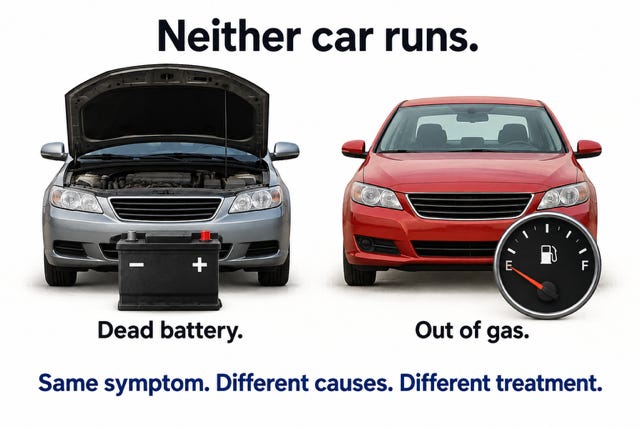
The clinical work is figuring out which problem you are actually dealing with.
That sounds obvious when you put it that way. Yet it raises an important question for clinicians working with cognitive decline: How much of our assessment is actually helping us localize dysfunction and understand what is happening neurologically?
Look Beyond the Labs
This was one of the most interesting threads in the conversation.
Dr. Glenn described patients for whom a deeper neurological examination revealed something that would not necessarily be apparent from laboratory testing alone.
He talked about looking at things such as eye movements, tongue deviation, gag reflexes, motor patterns, arm swing and postural control. These observations can provide information about neurological function and help guide what he looks at next.
He gave one example of a patient with longstanding constipation who had not responded as expected to interventions aimed at detoxification. Going back and performing a more detailed neurological examination led him to identify evidence of an old brainstem injury that changed how he approached the case.
His advice to the group was simple:
Start thinking beyond the labs. Examine the patient.
For clinicians who already have a strong functional medicine foundation, that opens up a whole additional set of questions.
Where is the dysfunction?
What pathway might be involved?
What function is impaired?
And what can be done to stimulate or rebuild that function?
Functional Neurology Adds Another Layer
Dr. Glenn described functional neurology as the “secret sauce” of his approach.
One area he spends considerable time assessing is visual and eye movement function. He uses specialized tools to evaluate pursuits, saccades, fixation and other aspects of eye movement, then uses that information to guide specific exercises.
He explained the concept to patients in much simpler terms than the underlying neuroanatomy.
The brain has different areas that need to communicate with each other. Sometimes the issue may be less about whether a particular area is functioning and more about how information is getting from one area to another.
He compared that to an old-fashioned telephone switchboard. The offices may be working perfectly, but if the switchboard connecting them is not working, the information still does not get through.
That is the kind of explanation patients can understand.
And it leads to a much more interesting question than simply asking which part of the brain looks abnormal on a scan:
What is the brain having trouble doing?
Neuroplasticity Becomes Part of the Treatment Conversation
Dr. Glenn also shared several examples of using targeted exercises to stimulate specific neurological pathways.
One example involved a patient with aphasia. By combining a motor activity with a language task, he observed an immediate change in fluency. He explained this through the principle that neurons that fire together wire together.
The larger concept is neuroplasticity.
We see it all the time. Someone has a neurological injury, loses a function, goes through rehabilitation, practices a movement repeatedly and gradually regains ability.
Dr. Glenn’s point was that clinicians already know this happens. The opportunity is learning how to think more specifically about what to work on and why.
That is where functional neurology becomes especially interesting for clinicians already treating cognitive decline.
The Patient Education Piece Matters, Too
The conversation also turned toward something much more practical: how to teach patients everything they need to know without repeating the same explanations at every appointment.
Dr. Glenn has been building short educational videos around common topics patients need to understand. Rather than producing highly polished lectures, he records simple two- or three-minute videos.
His advice was particularly good for clinicians who tend to overthink content:
Don’t overproduce it.
Patients want to hear from you.
A short explanation recorded on your phone can be more useful than spending weeks trying to create the perfect educational presentation.
Those videos can then be connected to automated patient education, so the appropriate information is delivered based on the type of visit or stage of the patient’s program.
The clinician explains it once.
The patient can watch it again.
And the practice does not have to start from zero with every new patient.
There Was Much More to This Conversation
The hour could easily have gone on much longer.
The group discussed how to recognize when functional neurology may be useful, how to find appropriately trained practitioners, how visual input relates to brain function, how postural changes may provide neurological clues, and how individualized cognitive exercises can be developed around a patient’s specific findings.
Dr. Glenn also shared resources for clinicians who want to learn more, while making an important point about the learning curve.
You do not have to know everything.
As he put it:
“You have to know who to call when you don’t know.”
That may be one of the most useful ideas for clinicians working in this space.
You can build your understanding of functional neurology without pretending to be a functional neurologist. You can learn enough to recognize when another layer of assessment may be valuable, know what questions to ask, and develop relationships with practitioners who have deeper training.
For clinicians already working with cognitive decline, that can open up an entirely different way of thinking about the patient in front of you.
Want to be part of these conversations? Book a Success Planning Call with TruNeura to learn more about joining the Mastermind and bringing the TruNeura Methodology into your practice.

